Scalable fabrication of freely shapable 3D hierarchical Cu-doped hydroxyapatite scaffolds via rapid gelation for enhanced bone repair.

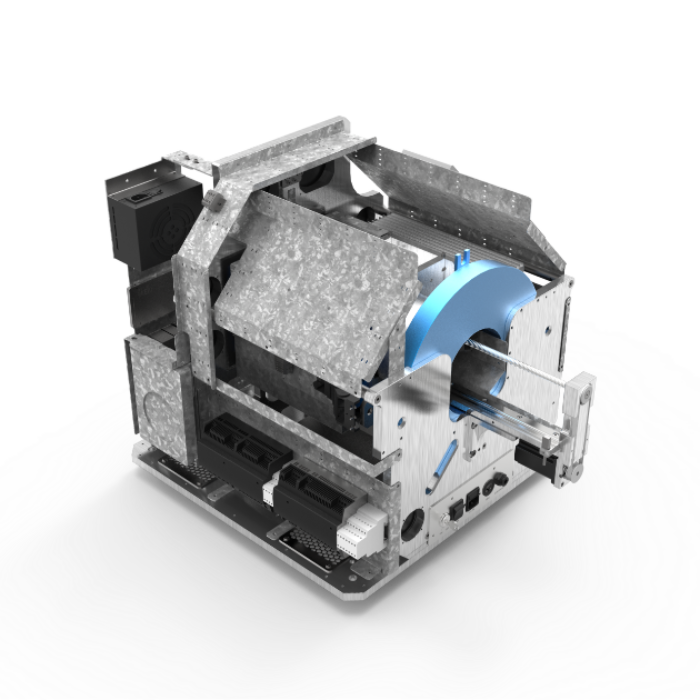
In this study by Yang et al., CT imaging using the X-CUBE (CT) was used to perform high-resolution 3D analysis of bone regeneration in rat cranial defects treated with copper-doped porous scaffolds.
Research question
The repair of larger-sized bone defects remains a challenge in tissue engineering, mainly due to the interplay of complex physico-chemical stimuli from the microenvironment required to promote bone repair.
Copper ions have been shown to stimulate the formation of new blood vessels (angiogenesis), which is a key step required in the bone healing process. These ions could be incorporated into existing biocompatible scaffolds, such as hydroxyapatite (HAp)-based materials, to enhance bone repair.
This study investigates whether copper-doped hydroxyapatite (Cu-HAp) scaffolds with a biomimetic hierarchical porous structure can be fabricated to effectively support bone tissue repair by enhancing both osteogenesis and angiogenesis in large cranial defects.
Experiment
A 5 mm full-thickness cranial defect was surgically created in rats, then filled with scaffolds containing different copper concentrations (0.8Cu-HAp, 1.2Cu-HAp, 1.6Cu-HAp).
After 6 and 12 weeks, the rats were euthanized, and the fixed skull samples were scanned using X-CUBE micro-CT for 3D imaging and quantitative analysis to evaluate bone regeneration. Micro-CT scans were performed using a voltage of 50 kV, current of 400 μA, and 50 ms exposure per projection.
The acquired images were reconstructed into 3D volumes using Molecubes software, followed by quantitative analysis using dedicated image analysis tools to assess bone mineral density (BMD) and bone volume percentages (BV/TV).
Results
Micro-CT imaging revealed time-dependent bone regeneration across all Cu-HAp scaffold groups. At 6 weeks post-implantation, new bone growth was observed along the inner surface of the skull defect, with all copper-containing scaffolds showing enhanced osteogenesis compared to the control. However, incomplete defect closure was still evident at this stage. By 12 weeks, bone density and scaffold integration had significantly improved in all groups, with the most pronounced effect seen in the 1.2Cu-HAp group.
Quantitative analysis confirmed these observations: bone mineral density (BMD) and bone volume fraction (BV/TV) increased with longer implantation time. Among the groups, 1.2Cu-HAp scaffolds demonstrated the highest BMD and BV/TV values, significantly outperforming both the 0.8Cu-HAp and control groups.
These results suggest that moderate copper incorporation optimally promotes bone formation, demonstrating strong potential as a strategy for bone tissue engineering.

Adapted from Yang, Hui, et al.